Samadhi retreats and courses
Part of every retreat David has led, and many online courses, over many years.

Attention difficulties are the norm in today's world. Many of us realise we haven't been listening to a colleague for five minutes, or that we drove home on autopilot. From waking to bedtime the mind is planning, worrying and going over what has happened. This talk looks at why our attention is so scattered, and how we can train it.
Buddhism and other contemplative traditions have developed detailed methods for training attention, and they can be taught in a fully secular way. David has trained in these methods with his teacher Dr B. Alan Wallace, a renowned scholar and teacher of Tibetan Buddhism, and brings them together with Western psychology and modern wellbeing research.
David explains the reality of our ordinary mind and its attention skills, and why everyone is somewhere on the attention spectrum, with or without an ADHD diagnosis.
For much of the 20th century, Western psychology treated attention as something we either have or don't. David explains why and how it can be trained, and how he has seen this himself.
Such as relaxation. Trying harder and fighting a wandering mind, like pulling a dog back on a lead, actually creates more tension and more distraction. So how do we deal with distraction?
Essential mental factors that help us develop and refine our attention skills over time.
Developing a calmer baseline in life, the ability to let go of 2am worries, greater clarity, and much more.
The talk includes a guided practice of mindfulness of breathing, and everyone gets PDF notes afterwards.
A clear, sharp knowing of what we attend to, without becoming dull or sleepy.
Staying with what we choose to attend to, without being carried off by distraction.
Ease in body and mind, breath by breath. Tension is a poor foundation and feeds distraction.
The three qualities David teaches in training attention. Relaxation is the foundation; stability and vividness are built on it.
Part of every retreat David has led, and many online courses, over many years.
Sessions on training attention for schools.
Sessions for therapists and counsellors.
A talk on training attention.
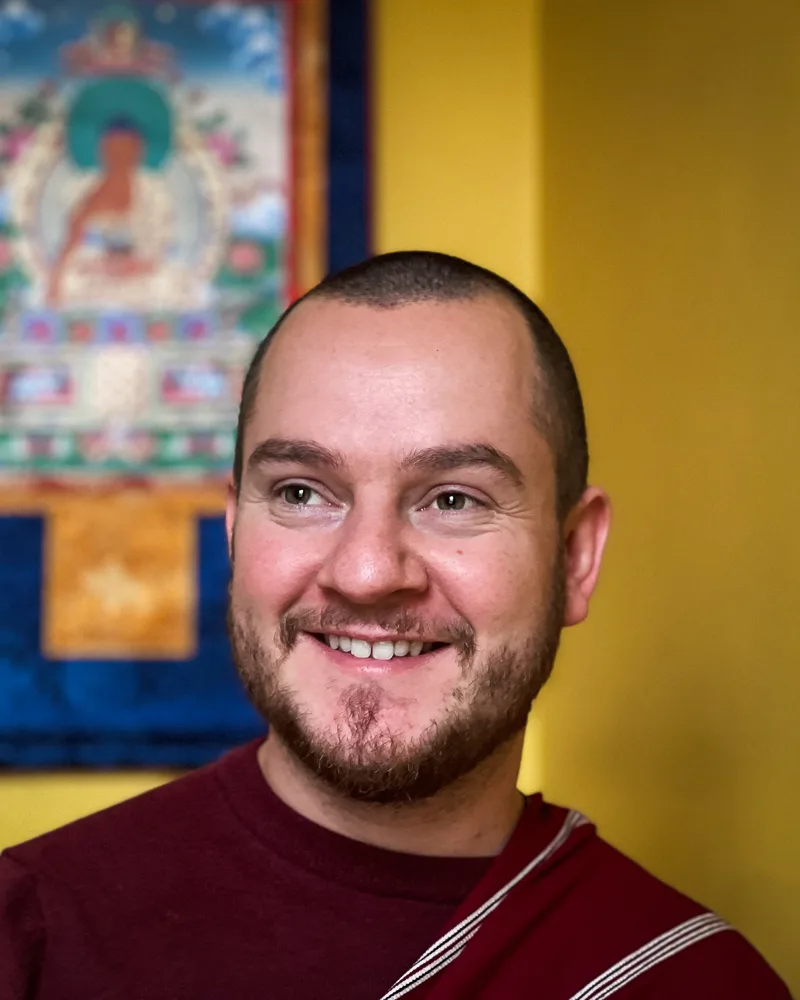
David started as a mental health support worker at eighteen and went on to work in Liverpool's mental health services, on the wards and in the community.
At his lowest he was signed off work for months, and he speaks about it openly.
He is a qualified mindfulness teacher and a Mental Health First Aider.
His root teacher is Dr B. Alan Wallace, a renowned scholar and teacher of Tibetan Buddhism, and David has trained in the Tibetan Buddhist tradition since 2015.
He wrote A Practical Guide to Mindful Living and Calm Mind, Open Heart, and co-founded Samadhi, a Buddhist wellbeing charity (1207744), where he leads retreats and courses across the UK and online.
David gives this talk to workplace wellbeing programmes, schools, colleges and universities, conferences and festivals, and NHS and frontline teams. It suits anyone whose work or study depends on focus, and anyone whose mind races when they are trying to sleep.
For festivals, summits and conference main stages.
With short guided practices, for 20 to 200 people.
For a team, including lunchtime guided meditations and Q&A.
Reduced rates are available for NHS, charity and educational bookings.
“David explains everything so carefully and thoroughly.”
“David, the teacher, gives simple but illuminating instruction with just the right amount of theory to motivate and reorientate to the practice.”
“David provides us with the tools to achieve a calmer and more mindful life and it is then up to us to put into practice what we have been shown.”
“The talk was really insightful and felt so relaxed after the meditation tried during the session.”
“David is very knowledgeable and a trusted source of advice on meditation and Buddhist philosophy.”
“David gave us very structured and clear teachings over the course of the 7 day retreat, diving deeper each day.”
From a 20-minute keynote to a full-day programme.
Yes. The talk includes a guided practice of mindfulness of breathing, and short practices people can use during a working day, such as counting seven breaths.
Yes. Everyone gets PDF notes after the talk.
Yes. David shapes every talk with the organiser, for example for an office team, a school staff room or a student group.
Both. Online keynotes and workshops run on Zoom.
David is based in South Wales and travels across the UK. International in-person bookings are considered case by case.
It depends on the format, so get in touch for a quote. Reduced rates are available for NHS, charity and educational bookings.
Tell us a little about your event and we will come back within two working days with availability, a fee and a rough idea of how a session could work for your audience.
