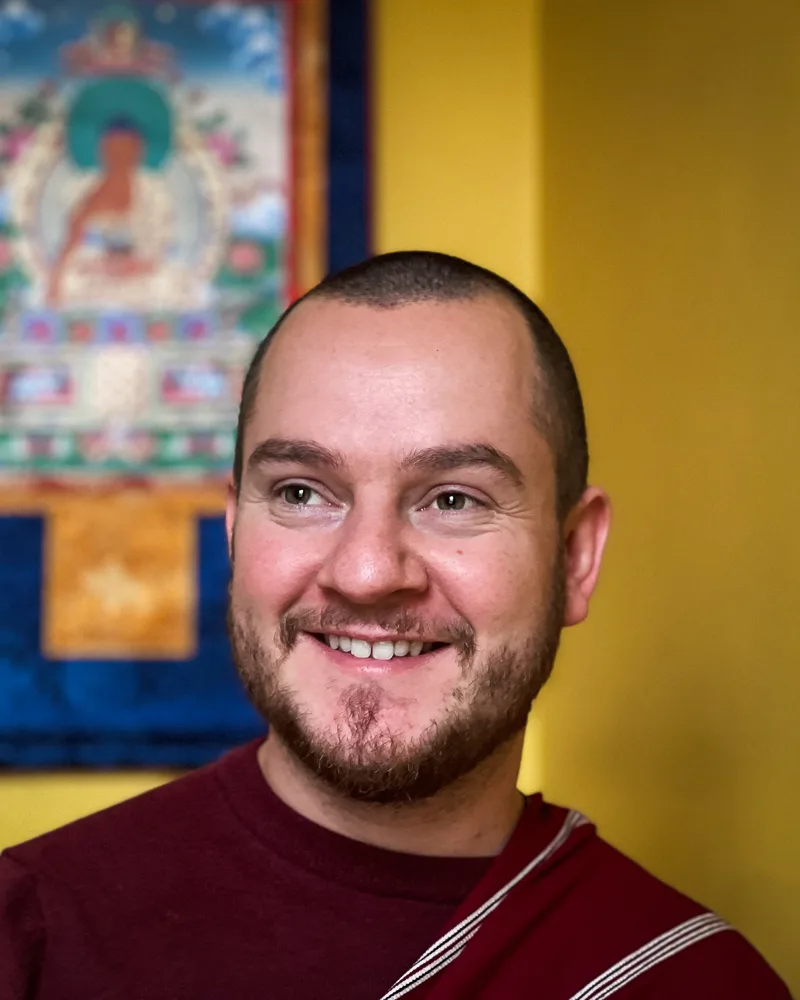
Meditation teacher, speaker & author
David Oromith is a Welsh Buddhist teacher, author, public speaker and meditation guide based in Swansea.
A late-night search led here
One night, at his lowest, David typed a desperate question into Google: "Why is life just suffering?" He'd been signed off work for months, and had been making plans to end his life. That search led him to Buddhism, and, eventually, to a different way of life.
"'Stress isn't something the world does to you; it's something we bring to the world.' That was a huge realisation for me. Once I realised I could change how I responded to life's difficulties, I found new hope."
David started out at eighteen as a mental-health support worker in Wales, then moved to Liverpool to train and work in the city's mental-health services, first on the wards, later out in the community, including a project supporting people living with long-term, severe mental-health conditions. He went into the work for one reason: he wanted to understand suffering and how to alleviate it. What he kept running into was a system that, stretched and underfunded, leaned heavily on managing symptoms and had little room to reach the root of why people suffered. He watched people cycle back through the same doors again and again. He was looking for what was missing.
Then it caught up with him. The wider world had started to feel overwhelming: relationships breaking down, illness close to home, a death in the family's circle, and a news and social-media feed that seemed to run on fear. The low mood he'd carried since his teens came to a head.
The first months after discovering Buddhism were a deep dive - local classes, a stack of books, and the relief and joy of finding something that helped. But that relief wasn't the end of the depression. When the initial honeymoon phase faded, and some of the old heaviness crept back, he had to do the slower work: training his mind, day by day, and working through what the teachings opened up. But the passion remained. A few years into his exploration, he came across a teacher online, Lama Alan Wallace, who felt, unmistakably, like his teacher.
When David and his husband Manu moved to Spain, his practice and understanding finally appeared to go deeper. With few other responsibilities, he spent the best part of two years in concentrated study and practice, the period that shaped most of what he teaches today.
What pulled him back outward was other people's suffering. Witnessing it around them in Spain stirred the same impulse that had taken him into mental-health work in the first place, and he and Manu, who had trained as a yoga teacher, began running small sessions from their home. People kept coming back. The sessions kept booking up. That was the beginning of Samadhi. It really grew when the couple returned to the UK and moved online and into in-person retreats, and it has kept growing since, supported by a warm and engaged community. Today, Samadhi is a thriving Buddhist wellbeing charity (1207744).
Over a decade on, David teaches what helped him in plain English, hoping not to make it complicated or mysterious. His approach blends classical Buddhist psychology with the practical tools he first met in mental-health work, such as mindfulness-based approaches, Dr Paul Ekman's emotional-balance framework, and clear, evidence-based thinking. Much of it comes back to a single, hopeful idea: that the mind can be trained, that we have more power over how we meet life than we think, and that changing how we relate to our experience changes how we feel and how we act. Through Samadhi he leads retreats and courses across the UK and online, and he speaks at schools, colleges, universities, festivals and events on stress, burnout, emotional awareness and the trainable nature of the mind.
His teaching is for anyone who knows suffering and wants a better way - carers, NHS staff, anxious professionals, and burnt-out people looking for something more grounded than quick-fix self-help or anything mystical.
David is the first to say he's nothing special. He's not finished, and he's not perfect, just someone who was struggling, and who found something that has helped. What he wants is simple: for other people to feel the same hope he found, and to have the same tools that changed things for him.
Trained in the Tibetan Buddhist Tradition
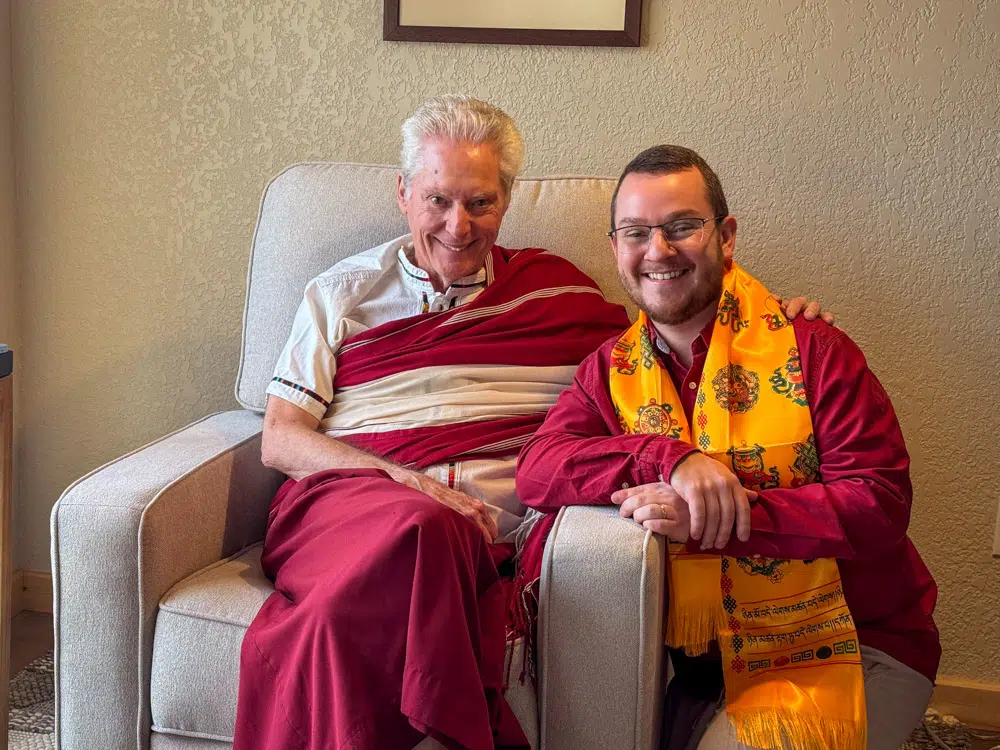
David's root teacher is Lama Alan Wallace, ordained by HH the Dalai Lama and a fourteen-year Tibetan Buddhist monk. Lama Alan is a renowned scholar, practitioner and teacher of Tibetan Buddhism and a prominent voice in the interface with science.
Through Lama Alan, David's lineage connects to the Dudjom Lingpa Nyingma Dzogchen transmissions (received by Lama Alan from Gyatrul Rinpoche), the Gelug tradition, and the non-sectarian rimé approach.
Further teachers and influences: HH the 14th Dalai Lama, Lama Lena, Ven. Robina Courtin, H.E. Garchen Rinpoche, Dilgo Khyentse Rinpoche (as textual commentator), and, on the psychological side, Dr Paul Ekman's Cultivating Emotional Balance programme.
What people say
David has such a wealth of information that he delivers in a humble but extremely knowledgeable way.
Retreat attendee, Devon
Highly skilled and so very approachable, mixed in with a good sense of humour, making the sessions really something to look forward to.
Retreat attendee, Lincolnshire
It is obvious the passion David has with his teachings and the genuine desire to help enhance the quality of peoples lives, which I personally find truly admirable.
Course participant, Online
I've been listening to the Samadhi podcast and I instantly found David's voice comforting… When I met him in person, he's very down to earth but at the same time, has a real presence about him. He makes his teaching so relatable and easy to understand. He has the ability to make you feel completely safe to be vulnerable… because of David and the kindness of others, I was able to open up and able to share and ask questions which helped me a lot to process things.Attendee, Devon retreat